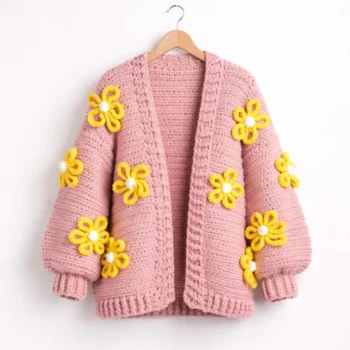
Crochet Cardigan Patterns
A cardigan is the project where crochet stops being a hobby and becomes part of your wardrobe. It is also where a lot of makers stall. Half a back panel sits in a bag for a year, or the finished piece comes off the hook two sizes too big and never gets worn. Neither of those is a stitch problem. They come down to choosing the wrong construction for your patience and the wrong size for your body. So this collection is organised around those two decisions first, and the stitch patterns second.
Four Ways a Cardigan Gets Built
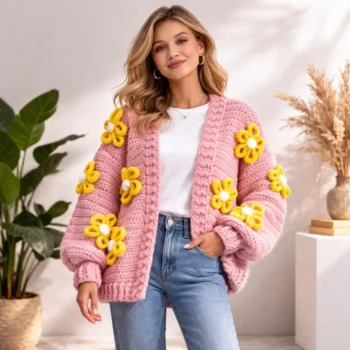
Panel cardigans are the honest beginner route. A back, two fronts and two sleeves, each one a flat shape worked in rows, then seamed together. If you can keep an edge straight, you can make one, and every piece is small enough to carry around. The trade-off is the sewing at the end, which some people enjoy and most people put off. Top-down cardigans start at the neckline and grow downward from raglan increases, so there is almost nothing to sew. Their real advantage is fit. You can slip the piece on halfway through and decide exactly where the hem and cuffs should stop. If you sit between two sizes, this is the construction to choose. Motif cardigans are built from repeated shapes. Granny square cardigans turn a pile of squares into a body and sleeves, which makes them the best use of scrap yarn there is. Hexi cardigans go further, using two large hexagons that fold into a cardigan almost by themselves, with very little shaping. If you have never joined motifs before, practise on our crochet granny square patterns first. Joining is where motif cardigans succeed or fail. Statement cardigans are the long game. Coatigans, cocoons and dusters use more yarn and more hours, but they are the pieces people stop you to ask about. Leave these until you have finished at least one simpler cardigan.
Why Fit Matters More Than the Stitch
Most handmade cardigans that never get worn fail on fit, not on looks. Crochet fabric is heavier and denser than knitting, and it keeps moving after you finish it. Cotton in particular can drop an inch or more in length once it has been worn and washed a few times. This is why every cardigan pattern here lists finished measurements and the intended ease, not just S to XL. The simplest way to choose a size is to ignore the size labels. Lay a cardigan you already own and love flat, measure across the chest and from shoulder to hem, and pick the pattern size whose finished measurements come closest. Then make a gauge swatch, wash it the way you will wash the cardigan, and measure again before you commit to the full project.
Yarn, Practically
Three things matter when you buy yarn for a cardigan. Weight comes first. DK and worsted cover most designs, and bulky yarn is for fast, thick cardigans and coatigans. Fibre is next. Cotton and linen blends suit spring and summer layers, and wool or wool blends suit autumn and winter because they hold heat and keep their shape. Then there is quantity. An adult cardigan usually takes somewhere between 900 and 1,800 yards depending on size, length and sleeves. Buy it all from one dye lot, plus one extra skein, because running out three rows from the end is the most common way a cardigan ends up unfinished. Every pattern lists the exact yarn used, along with alternatives at different price points.
How Long a Cardigan Really Takes
A cropped cardigan in DK yarn takes around 15 to 25 hours. A hexi or granny square cardigan takes 20 to 35 hours, most of them spent on the motifs. A chunky oversized cardigan works up faster than you would expect, at around 12 to 20 hours, thanks to the bulky yarn. A long duster or coatigan can easily pass 40 hours. The practical rule follows from those numbers: start a cardigan a season before you want to wear it. Open our winter crochet patterns and fall crochet patterns for cozy layers in late summer. Open our summer crochet patterns and spring crochet patterns for lightweight cotton cardigans while it is still cold outside. Everything else, season by season, is in the seasonal crochet collection.
What Comes With Every Cardigan Pattern
You get an instant PDF download that is yours to keep, with no subscription. The pattern is written in US crochet terms, with a UK conversion key on the first page. Stitch counts are given at the end of every row, and photo tutorials cover the steps that usually trip people up, such as seaming, picking up a button band or joining motifs. There is a schematic with finished measurements for every size. A small-business licence lets you sell the cardigans you make. And if a row does not work out, you can email a real person for help. If you would like to see how the patterns are written before buying one, start with our free crochet patterns.
Where to Go Next
If a garment feels like too big a step right now, a crochet blanket builds the same stamina with no fitting at all. And if you are making a cardigan as a gift, look at the dates first. A Christmas cardigan needs to be on the hook by October, so browse our Christmas crochet patterns and the rest of our holiday crochet patterns early.
Frequently Asked Questions
Is a cardigan a good first crochet garment?
Yes, as long as it is a panel or top-down design. A cardigan is more forgiving than a jumper because the open front hides small sizing errors, and it is easier to wear while you are still learning how crochet fabric drapes.
How much yarn do I need for a crochet cardigan?
Most adult cardigans use between 900 and 1,800 yards, depending on size, length and sleeve style. Always use the yardage listed for your size in the pattern, and buy one extra skein from the same dye lot.
Why did my crochet cardigan get longer after I wore it?
Crochet fabric is heavy, and gravity pulls it down over time, especially in cotton. Choosing a wool blend, using a slightly smaller hook and drying the cardigan flat all reduce the stretch.
Should I choose a top-down or a panel cardigan?
Choose top-down if fit is your priority and you want to avoid seaming. Choose panels if you want simple flat pieces that are easy to follow and to carry around.
How long does it take to crochet a cardigan?
Between about 12 and 40 hours or more. Chunky cardigans are the fastest, and long dusters and motif-heavy designs are the slowest.
Can I sell the cardigans I make from these patterns?
Yes. You can sell finished cardigans you have made yourself, online or at markets. You cannot share or resell the pattern file itself.